
I don’t start the day wondering what to write the topic finds me. Every morning brings news, earnings, or rumour that creates an explosion of volatility: fact and supposition collide and markets move. The art of investing has changed. Today, success demands an additional, essential skill: recognising risk and opportunity in real time and then either avoiding or exploiting them.
It isn’t the analyst report that moves the needle. It’s understanding what the market already knows, and what it is willing to pay for that information. What do you do when cybersecurity names plunge 20% in a day, or when consumer discretionary stocks trade at historic premiums to intrinsic value and look one rotation away from deflating? Where is your reference point of price versus value? How do you acknowledge risk every day? How are you alerted to it?
The rise of passive investing, ETFs and the retail herd has changed the game for active managers. When these tribes move together they create powerful momentum and sometimes extremes that inflict real pain. Research is essential, but it’s increasingly commoditised and freely amplified by AI. The edge has become knowing what the market knows, knowing what it’s paying for, and making a timely decision (or deliberately choosing not to).
A few years back a sharp portfolio manager likened Apollo to a camera: you look at the image and instantly understand the story. That’s the right mental model. Everyone needs a camera to capture the moment.
Which brings me (in a round about way) to the chart – The Apollo Margin of Safety. The white line is the share price; the blue line is Apollo’s intrinsic‑value trend. The Margin of Safety bands cash‑in on asymmetry: PutZERO at the top (100%), CallZERO at the bottom (0%). Between them, the 20% line signals a Value long; the 80% line signals an overvalued setup where downside materially outweighs upside.
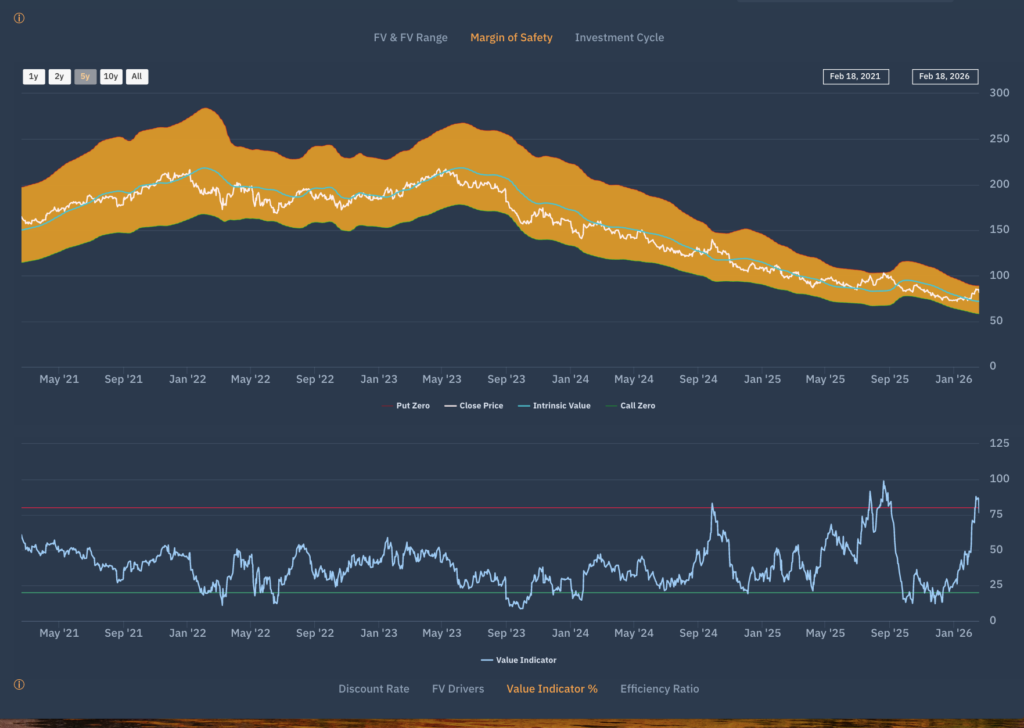
The company name on the chart is irrelevant. It’s the story that the image tells that’s important, which is where and when was the opportunity to buy, or cover a short position and when, importantly how many opportunities were there to sell which was inexcusable.
Without real‑time data and a framework that translates price into probabilistic outcomes, you are flying blind. The cockpit is dark. The difference between surviving and thriving in today’s markets is not just good research being alerted to the Need to Know moments and doing something (or actively doing nothing) about it.